
Are You a Control Freak?
I’ve recently returned from working with a school in Melbourne where I hear a common phrase in staffrooms all over the country.
"Yeah, but..."
You probably know the version.
-
"Yeah, but we're understaffed."
-
"Yeah, but leadership won't change."
-
"Yeah, but that's not how things work here."
And to be fair, many of those statements contain truth. Schools are operating under immense pressure. Workloads are high, expectations continue to grow, and there are many aspects of education that feel frustratingly outside our control.
But as I listen to these conversations unfold, I like to offer a simple reframe.
What if we replaced "Yeah, but..." with "Yes, and..."?
It might sound like a small shift in language, but language shapes thinking, and thinking shapes action.
-
"Yes, the system is challenging, AND what is one thing I can influence?"
-
"Yes, there are barriers, AND what strengths can I bring to this situation?"
-
"Yes, things aren't perfect, AND how do I want to show up anyway?"
This is where wellbeing intelligence becomes so important.
Many people assume wellbeing is about learning more strategies, collecting more resources, or finding the next thing that will finally make work feel easier. But wellbeing intelligence is something deeper. It is the ability to notice what is happening within us and around us, and then respond intentionally to what we need in that moment.
It is awareness before action.
It is recognising that while we cannot control everything happening around us, we still have choices about how we think, communicate, connect and contribute.
One of the models I use to explain the complexities of wellbeing at work it an ecological lens of Me – We – Us.
-
The "Me" refers to our personal wellbeing choices.
How am I thinking? How am I feeling? What do I need?
-
The "We" refers to how we interact with the people around us.
How am I contributing to the relationships and culture of my team?
-
The "Us" refers to the broader system.
What kind of workplace are we creating together?
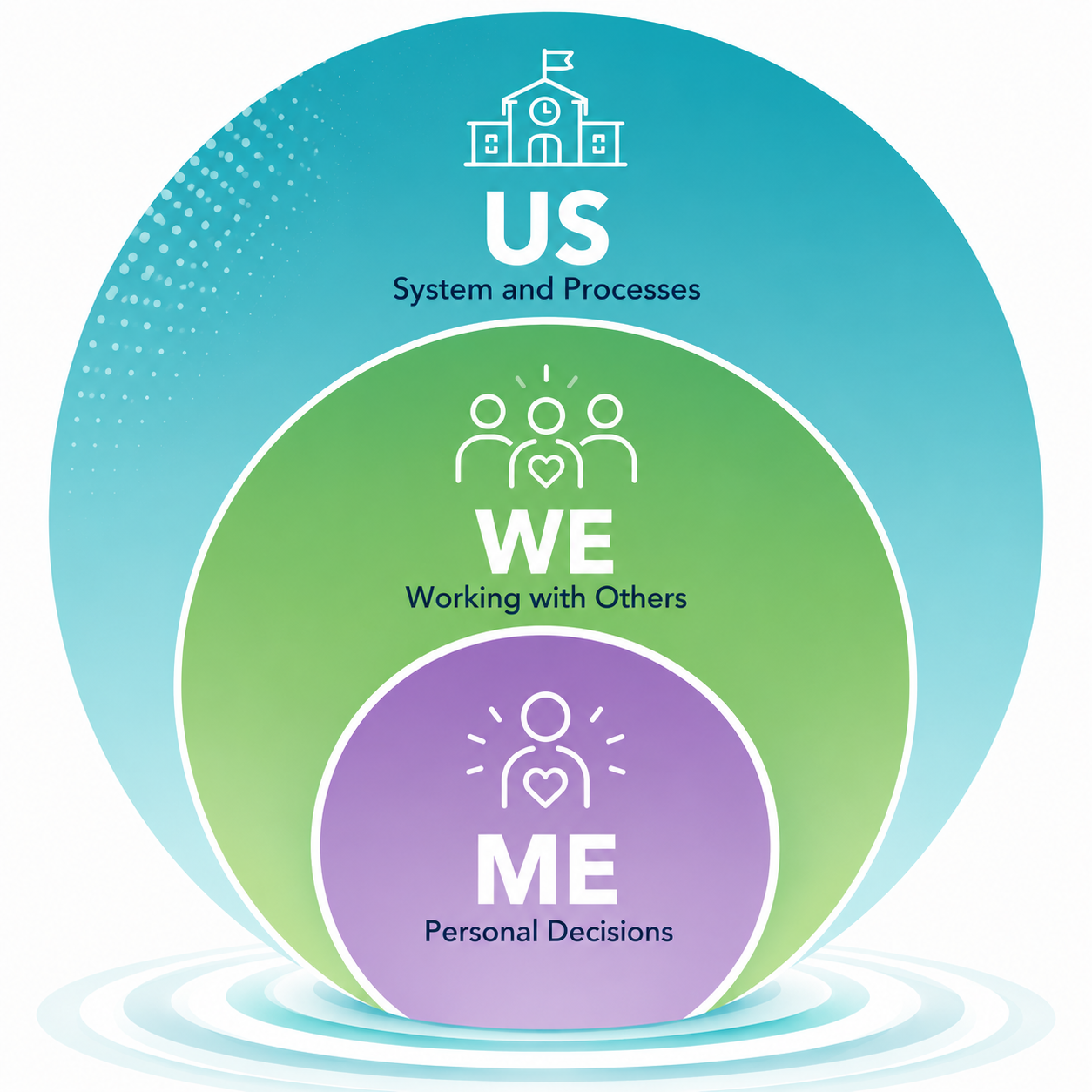
Too often, we wait for change to happen at the "Us" level before we feel able to make changes at the "Me" level. Yet culture is built through thousands of daily interactions, decisions and behaviours. The system influences us, but we also influence the system. It’s reciprocal.
Every conversation, every act of kindness, every boundary we set, every assumption we challenge sends a ripple outward.
This is not about placing responsibility for wellbeing entirely on individuals. Systems matter enormously. But it is about recognising that we may have more influence than we realise.
The question is not simply, "How is the system affecting me?"
The question is also, "How am I affecting the system?"
When we begin to ask both questions, we move from feeling powerless to becoming active participants in creating cultures of care.
One Small Shift
This week, spend a few moments reflecting on three questions:
-
What value do I add to the system?
-
What value do I add to the people I work with?
-
What do I value about myself?
Notice what comes up for you.
Often, we are much quicker to identify what is missing than to recognise what we are already contributing. Sustainable staff wellbeing begins when we take responsibility for our own wellbeing while also acknowledging the impact we have on others.