
Ever Wondered If It’s Worth It?
I've been fortunate enough to spend the last few weeks cruising the Mediterranean through Spain, Italy and Greece, and while I've loved every new place, one thing has stayed with me more than anything else.
It's the people.
Every conversation reminded me that everyone has a story. Different backgrounds, different cultures, different experiences, different worries. We all arrive ruminating on things that other people know nothing about.
Yet the more people I met, the more I found myself thinking that underneath all those differences, we're probably not that different after all.
I think, at the end of the day, most of us just want to know that what we do matters.
Not in a grand, award-winning sort of way. Just in the ordinary moments of life. We want to know that our contribution counted for something, that we made someone's day a little easier, solved a problem, helped someone learn, or left things a little better than we found them.
Maybe that's why schools can be such rewarding places to work... and such exhausting ones at the same time.
We pour so much of ourselves into the work. Our thinking, our energy, our patience, our problem-solving. Sometimes I think educators have a remarkable ability to hold everyone else's needs while quietly putting their own to one side. Then we get in the car at the end of the day and wonder whether any of it actually made a difference.
I know I've certainly done that. I've also perfected the art of replaying a conversation in my head and coming up with the perfect response somewhere between the school gate and home. It's a wonderful skill... completely useless by that stage, but impressive nonetheless.
While I've been away, I've also been reading about a concept called relational energy, introduced by Owens, Baker, Sumpter and Cameron. They describe it as the psychological resource we gain through our interactions with other people—the kind of interaction that leaves us with more capacity, not less, to do our work.
When I read that, it immediately made sense.
We've all walked away from conversations feeling lighter, clearer and ready to tackle whatever comes next. We've also had conversations that somehow leave us feeling flat, even though nothing particularly difficult was said. It's easy to blame workload for that feeling, but I wonder if it's often our interactions that make the biggest difference.
That has made me think differently about communication.
I used to think communication was mostly about explaining things well. These days, I think it's much more about creating shared understanding. There's a big difference.
Because I've lost count of the number of times I've explained something, watched everyone nod in agreement, only to discover a week later that we all walked away with completely different interpretations. Nobody was wrong. Nobody wasn't listening. We were simply filling in the gaps differently.
That's why I'm becoming increasingly convinced that healthy workplaces don't just have good communicators; they have good communication systems.
They make expectations clear. They summarise decisions before people leave the room. They check for understanding instead of assuming it. Those small habits reduce confusion, prevent unnecessary frustration and, over time, build the kind of relational energy that helps people do their best work.
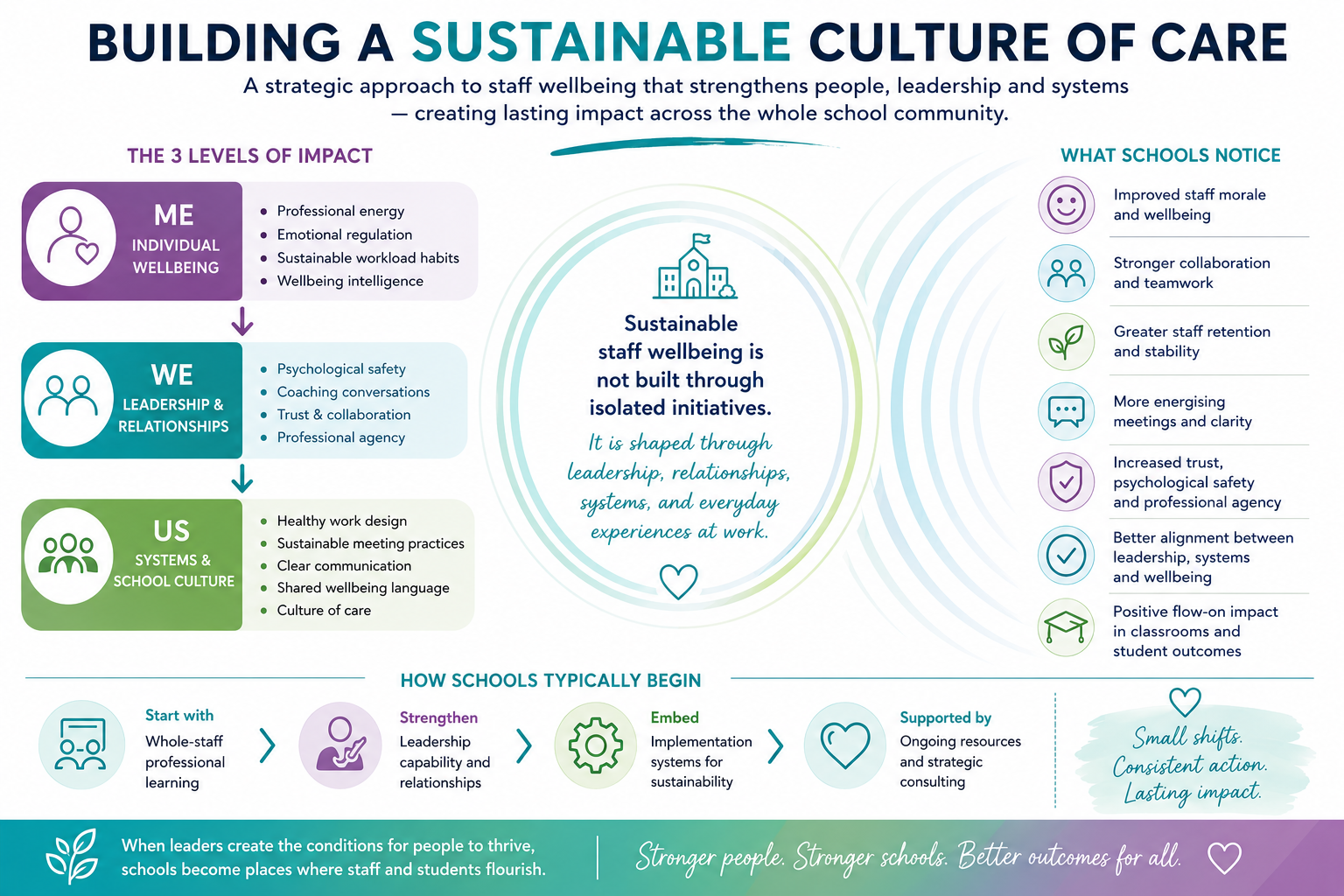
That is what creating sustainable staff wellbeing systems are all about.
One Small Shift
This week, before you finish an important conversation or meeting, try asking:
"Before we wrap up, can we check we're taking away the same understanding?"
It sounds simple, but that one question can prevent a lot of misunderstanding later.
And who knows... it might even save you from replaying the conversation in the car on the way home.