
What If Wellbeing Was a People Problem?
If you're reading this during the holidays, I hope you've found at least a few moments to slow down and catch your breath after another busy term.
One of the things I love about school holidays is that they give us a little space to reflect.
When we're in the middle of the term, we're often moving so quickly from one thing to the next that we don't always notice what's affecting us. Then the holidays arrive and suddenly we have room to think.
As I've been reflecting on the term that's been, I've found myself coming back to a topic that often shows up in coaching conversations, workshops and staff wellbeing sessions.
PEOPLE.
Because when we think about what influences our wellbeing at work, people are usually somewhere in the picture.
The colleague who checks in when we're having a tough day. The leader who sees our strengths and helps us grow. The teammate who makes us laugh when everything feels serious and overwhelming. These people can have a powerful positive impact on our wellbeing.
At the same time, we've all experienced the other side too. The difficult conversations, the misunderstandings, the negativity, the ongoing frustrations that leave us driving home wondering, "Why was that so hard?" or my favourite, “What is wrong with people?”
Can you relate?
The other day a teacher said to me, "I'm just tired of the drama in the staffroom."
At first, it sounded like the problem was other people. But as we explored the situation together, something interesting emerged.
She cared deeply about her colleagues and wanted to support them. Whenever someone was struggling, she stepped in to help. Whenever there was tension, she tried to smooth things over. Whenever a problem arose, she felt responsible for finding a solution.
The challenge was that despite all her effort, very little seemed to change. What did change was her energy. The more she invested in fixing everyone else's challenges, the more depleted her mental and emotional energy became.
One framework we explore in the Reignite Room is called the Drama Triangle. Developed by Stephen Karpman, it describes three common roles that many of us move between when we're under pressure: the Victim, the Rescuer and the Persecutor.
This framework helps us understand that while people influence our wellbeing, it is our own patterns that sometimes keep us stuck.
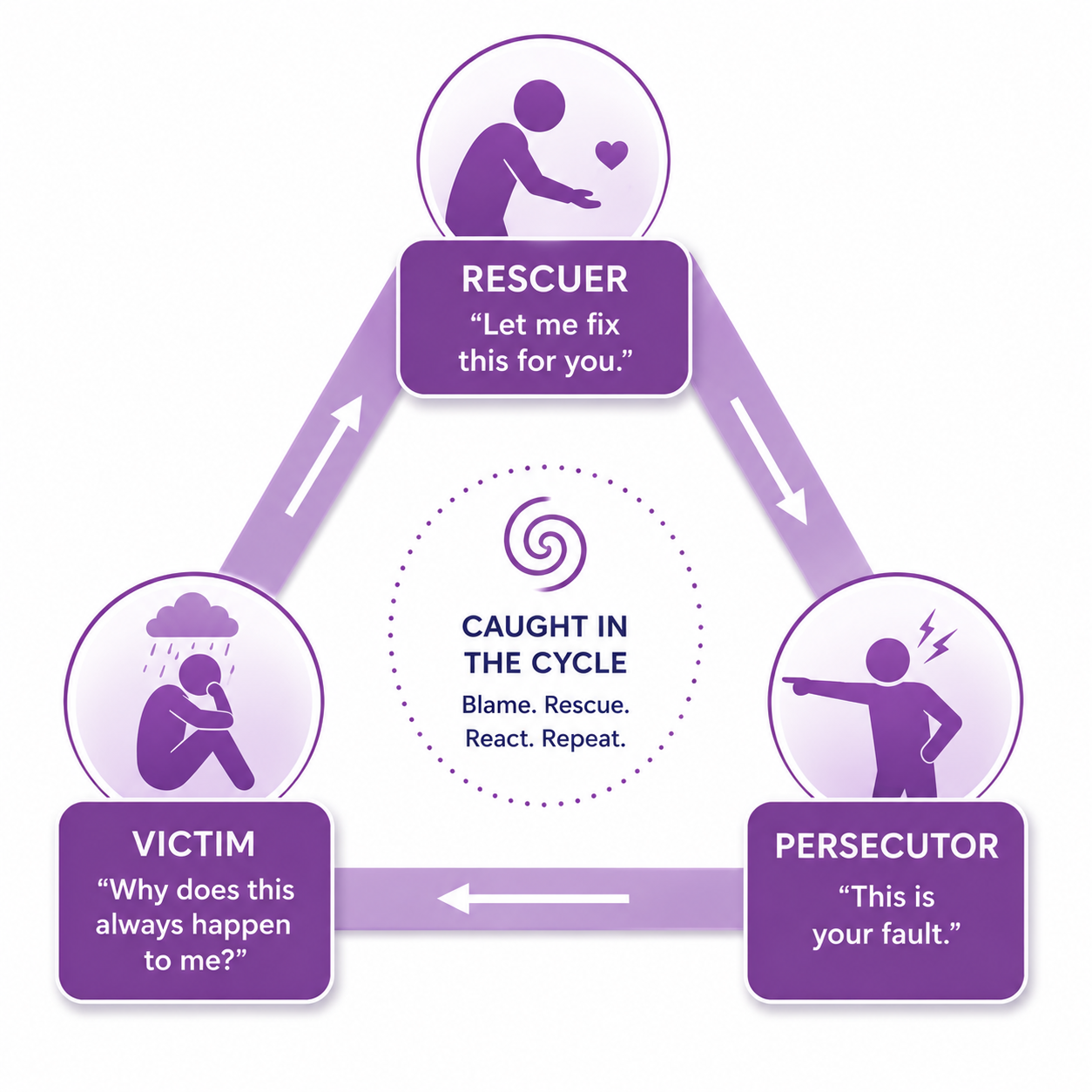
Most of us have played all three roles at different times. I know I certainly have.
The value of the framework isn't in labelling ourselves or other people. It's in helping us notice the patterns that keep us stuck. Because when we become aware of our patterns, we create choice.
And choice is a key part of wellbeing intelligence.
It's the ability to pause and ask, "Is this mine to solve?" rather than automatically jumping in. It's recognising when we're carrying responsibility that belongs to someone else. It's understanding that supporting people doesn't always mean rescuing them. Other people's drama is not ours to carry.
One Small Shift
Think about the dynamics in your staffroom, what do you notice about the different roles people play?
What do you notice about yourself when someone brings you a problem? Do you jump in to help with a solution, or do you pause and ask a question such as, "What have you already tried?" or "What do you think would be most helpful?"
Sometimes the most supportive thing we can do is create space for others to think, rather than doing the thinking for them.