The Sustainable Staff Wellbeing System
Stop running wellbeing initiatives. Start building a school where people can work well together.
The Sustainable Staff Wellbeing System is a practical 12-month leadership and implementation program that helps schools move beyond one-off wellbeing activities and create the leadership practices, workplace systems and shared responsibility needed for sustainable staff wellbeing.
Because most schools do not need another wellbeing initiative.
They need a clearer way to understand what is really influencing staff wellbeing, what leaders can reasonably influence, what staff need to take responsibility for, and how everyone can work together to create healthier ways of working.
Book a Strategy ConversationTrusted By Schools Across Australia and Beyond
I have worked with:
400+schools
8000+ educators
Across Australia, NZ, Hong Kong, Signapore



You care about your staff. But staff wellbeing keeps getting harder.
You may already be investing time, money and energy into staff wellbeing.
You might run staff development days, wellbeing weeks, morning teas, check-ins, social events, guest speakers or access to an employee assistance program.
These activities can be valuable. They can create moments of connection, recognition and relief, but they rarely address the whole picture.
Staff may still feel overloaded.
The same frustrations continue to appear in surveys.
Leaders may feel blamed for issues they cannot completely control.
Staff may expect the school to “fix” their wellbeing, while leaders struggle to build ownership and shared responsibility.
Conversations about workload, change, support and culture can become tense, personal or divided.
Meanwhile, the leadership team is trying to navigate school improvement, staffing shortages, compliance expectations, psychosocial health and safety responsibilities, competing priorities and the daily reality of running a school.
It is exhausting.
And adding another wellbeing initiative to an already crowded calendar is unlikely to solve it.
The problem is not that schools do not care
The problem is that staff wellbeing is often treated as a collection of activities rather than a way of working.
For years, the dominant conversation has focused on helping educators cope better, become more resilient or practise more self-care.
Those strategies still matter, but they are only one part of the picture.
Staff wellbeing is also shaped by:

Workplace demands and resources

Role clarity and autonomy

Communication and decision-making
Recognition and support
Trust and psychological safety
Leadership practices
Relationships between colleagues
The systems people experience every day
This means staff wellbeing cannot sit solely with the individual.
But it also cannot sit solely with the principal.
It is reciprocal.
Individuals have responsibilities. Leaders have responsibilities. Systems matter too.
The Sustainable Staff Wellbeing System helps your school understand these different layers and create a shared, practical approach to improving them.
A different question creates a different response
Instead of asking:
“How do we make people feel better?”
We ask:
“How do we build the capability for people and organisations to work well together, even when the work is demanding?”
That shift changes everything.
It moves the conversation:
From personal blame to shared responsibility
From isolated activities to intentional systems
From reacting to complaints to identifying what can be influenced
From staff wellbeing as an extra to staff wellbeing as part of how the school works
From compliance to care
The program is grounded in organisational psychology, positive psychology, psychological health and safety, implementation science and school improvement research. It recognises that sustainable wellbeing is created through the interaction between people, relationships, leadership practices and workplace conditions.
Introducing the Sustainable Staff Wellbeing System
This is my signature 12-month implementation program for school leadership teams.
It gives leaders the structure, professional learning, tools and support needed to understand what is shaping staff wellbeing in their context and take practical action without creating another committee or disconnected initiative.
Over 12 months, I work alongside your senior leadership team to help you:

Build shared language

Strengthen leadership capability

Improve staff voice, ownership and engagement

Understand psychosocial hazards more clearly

Review the systems shaping culture

Identify realistic priorities

Develop a Culture of Care Framework

Embed practical changes into everyday practice
This is not a program that is delivered to your school and forgotten.
It is a supported implementation process designed to build capability within your school.
Most wellbeing programs help staff feel better
This program helps schools work better
The Sustainable Staff Wellbeing System does not dismiss individual wellbeing, self-care or resilience.
They matter.
But asking staff to become more resilient while ignoring the conditions making work unnecessarily difficult is not sustainable.
At the same time, asking leaders to personally solve every wellbeing concern is neither realistic nor helpful.
This program creates a more balanced approach.
It helps staff understand their own professional wellbeing and the contribution they make to workplace culture.
It helps leaders identify the practices and systems they can influence.
It helps the school create shared responsibility for better ways of working.
The Three Foundations of Sustainable Staff Wellbeing:
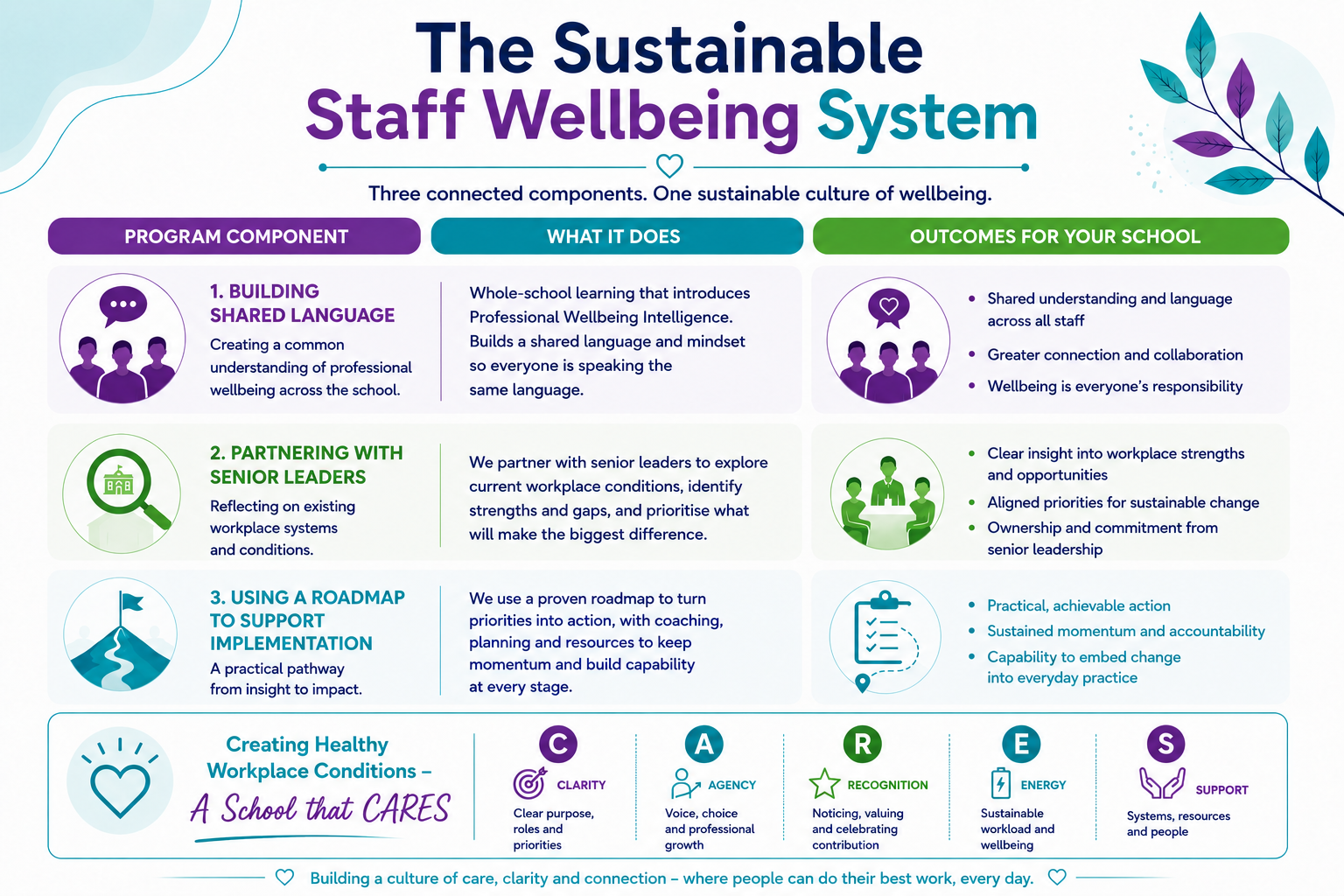
1. Building Shared Language
Meaningful change begins with a shared understanding.
Staff wellbeing conversations often become unproductive because people are using the same words to describe very different issues. One person may be talking about a personal challenge, another about relationships within the team, while someone else is identifying a genuine workplace issue.
Without a common language, every concern can feel like a leadership problem and every response can feel inadequate.
Through the Staff Wellbeing Booster Program, staff develop Professional Wellbeing Intelligence—a practical understanding of the personal, relational and organisational factors that influence wellbeing at work.
The result is more than increased awareness. Schools develop a shared language that strengthens conversations, encourages personal responsibility and provides a common foundation for improving workplace wellbeing.
The outcome is not simply more knowledge.
It is better conversations, greater personal ownership and a shared starting point for discussing wellbeing.
2. Partnering with Senior Leaders
Creating healthy workplaces requires more than good intentions. It requires thoughtful leadership and intentional workplace design.
Rather than introducing another wellbeing initiative, we work alongside senior leaders to understand the conditions that shape the everyday experience of staff.
Together we reflect on questions such as:
-
Where are our current strengths?
-
Where is unnecessary friction making work harder than it needs to be?
-
Which workplace systems are supporting wellbeing?
-
Where are the greatest opportunities for improvement?
Drawing on organisational psychology and contemporary workplace wellbeing research, we help leadership teams identify practical ways to strengthen clarity, agency, recognition, energy and support across the school.
The goal is not to redesign everything. It is to help leaders make informed decisions that create healthier workplace conditions over time.
3.A Roadmap to Support Implementation
Sustainable change happens through consistent action, not isolated initiatives.
Many schools already know what they want to improve. The challenge is finding the time, structure and accountability to turn good intentions into everyday practice.
Using the 6E Roadmap, we support schools to move from insight to implementation through a practical, staged approach.
Together we:
-
identify priorities
-
build shared understanding
-
develop capability
-
evaluate progress
-
embed new practices into everyday routines
-
continue refining and strengthening workplace systems over time.
Rather than adding another program, the roadmap helps schools integrate wellbeing into the way they already lead, communicate and work together.
The Outcome
These three foundations work together to create healthy workplace conditions—a school that CARES.
A school that CARES creates:
-
Clarity through shared purpose and clear expectations.
-
Agency by giving people voice, ownership and opportunities to contribute.
-
Recognition where people feel valued for the difference they make.
-
Energy through sustainable workloads and healthy ways of working.
-
Support through systems, structures and relationships that help people succeed.
This is how wellbeing moves beyond isolated initiatives to become part of how the school operates every day.
What's Included
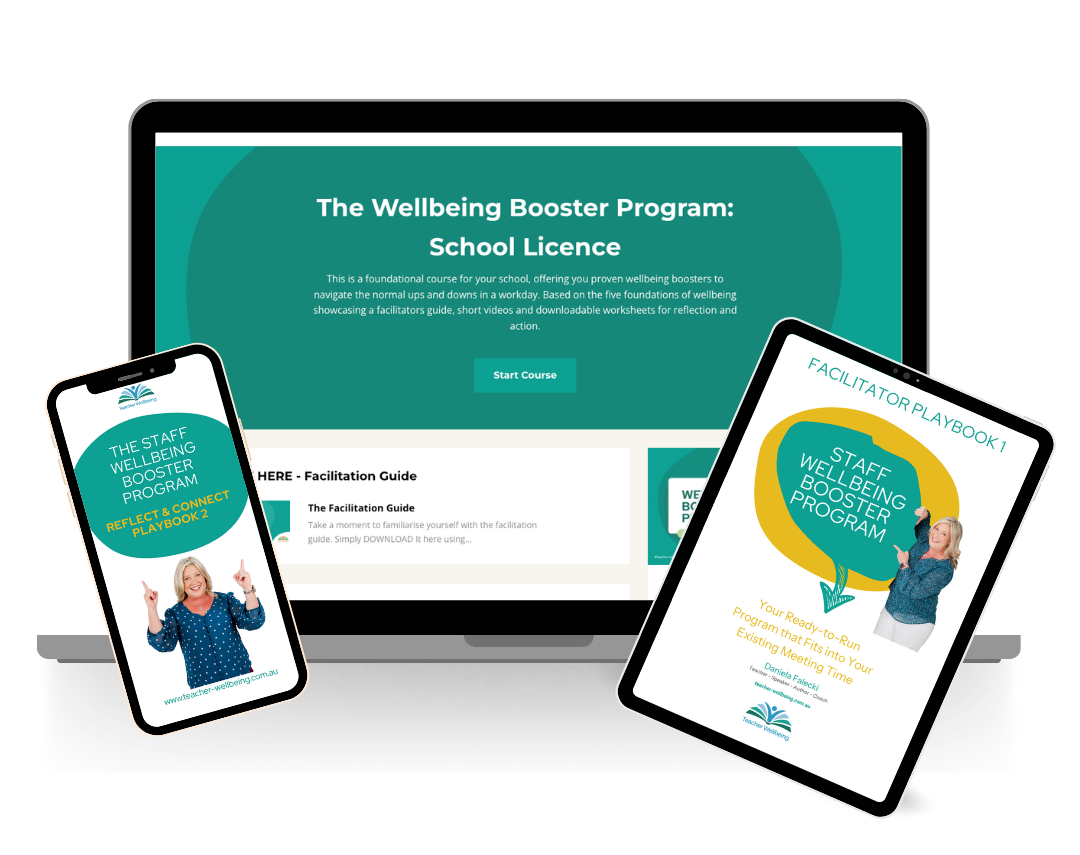
The Staff Wellbeing Booster Program
Your school receives 12 months of access to a school-led online program containing ready-to-use wellbeing learning for staff.
The program includes:
✔️ Seven Professional Wellbeing Intelligence modules
✔️ Short staff learning activities
✔️ Facilitator guides and lesson plans
✔️ Discussion prompts
✔️ Staff reflection resources
✔️ Practical tools and worksheets
✔️ Wellbeing check-ins
✔️ Resources for staff meetings and professional learning
Each booster is designed to take approximately 20 minutes and can be delivered within your existing meeting or professional learning structures.
Staff commitment: Approximately two 20-minute sessions per term
Leader preparation: Approximately 10 minutes per session
Senior Leadership Consulting
Partnering with senior leaders, exploring the science and application of sustainable staff wellbeing across 12 months.
The sessions includes:
✔️ Organisational approaches to staff wellbeing
✔️ Psychosocial hazards in school settings
✔️ The interaction between individual, relational and system factors
✔️ Professional Wellbeing Intelligence
✔️ Leadership practices that influence culture
✔️ Practical tools for communication, engagement and psychological safety
✔️ Your school’s current strengths and pressure points
✔️ The foundations of your implementation roadmap
Delivery option: Full-day in person or half-day live online.
Plus three online implementation sessions (approximately two hours per session).
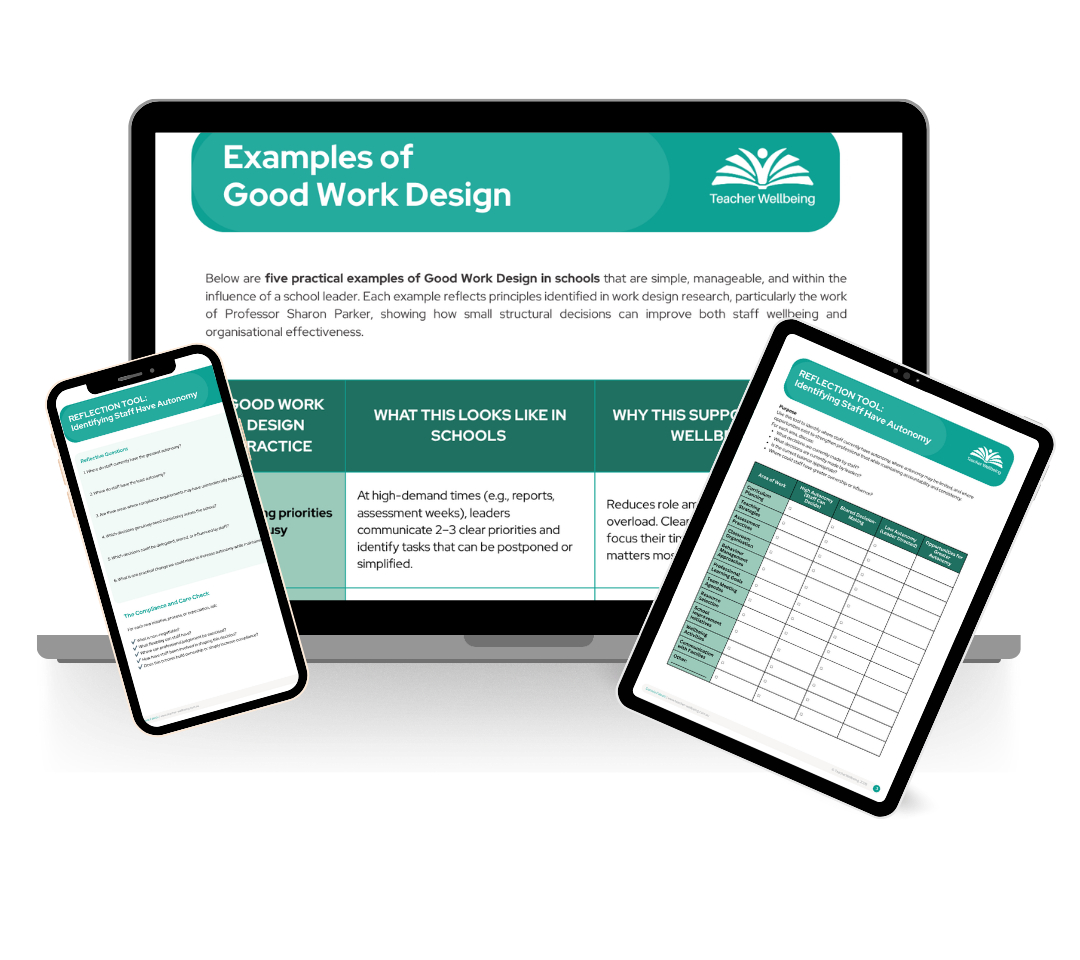
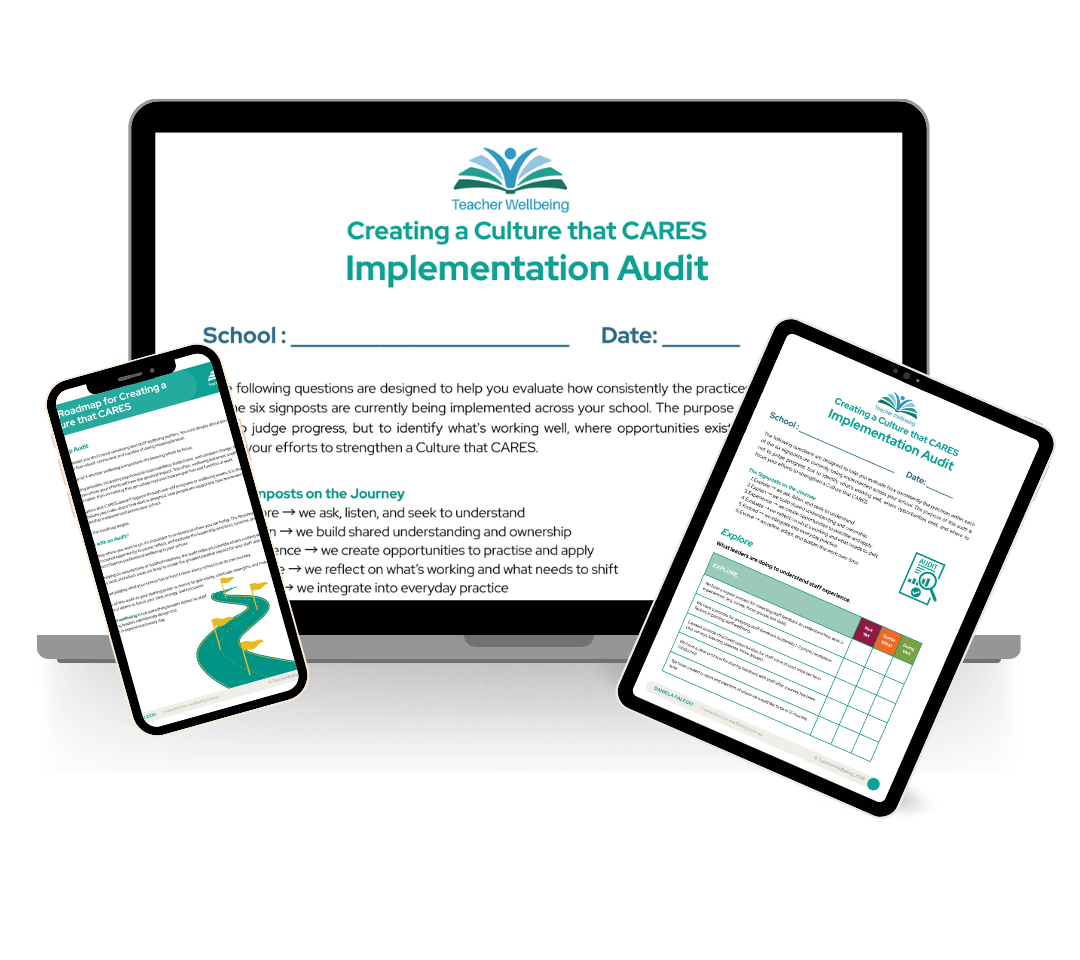
Roadmap & Leadership Toolkit
You will receive practical implementation tools to support the work, including:
✔️ A workplace wellbeing audit
✔️ Priority-setting resources
✔️ Action-planning templates
✔️ Leadership reflection tools
✔️ Staff feedback resources
✔️ Communication tools
✔️ Meeting and recognition strategies
✔️ Implementation check-ins
✔️ A framework development guide
✔️ Ongoing email support
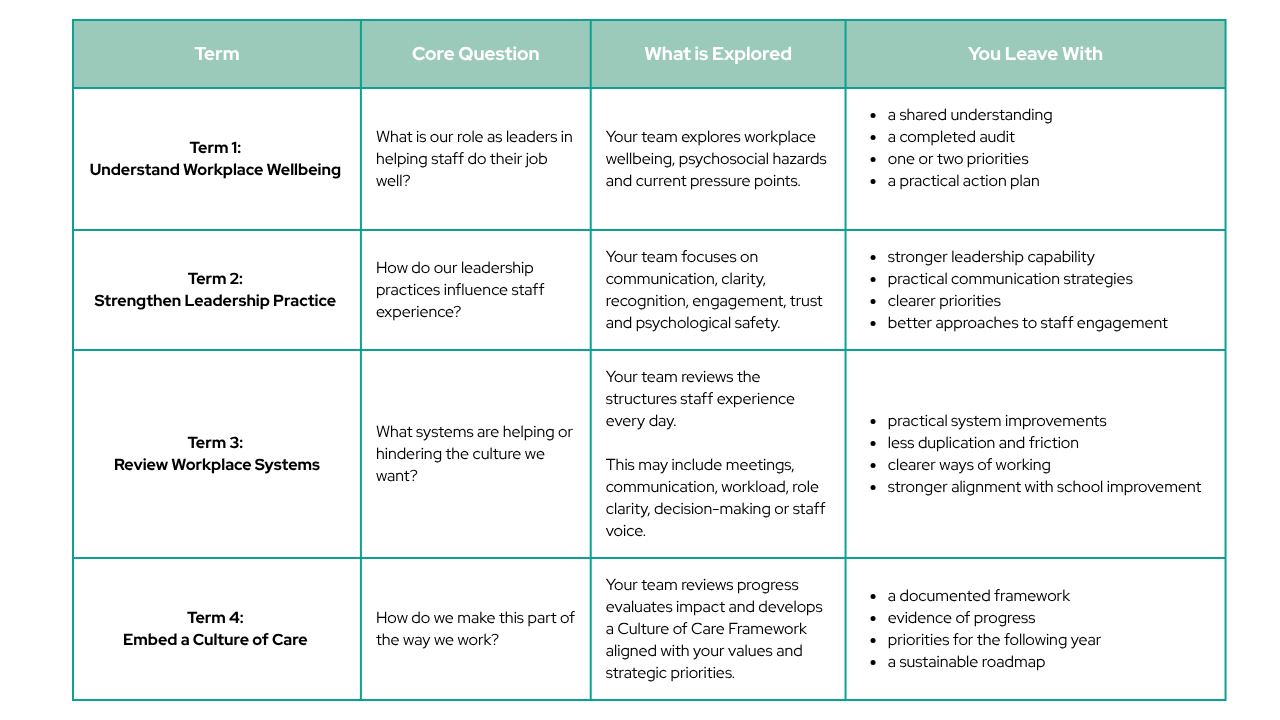
The 12-Month Journey






Imagine What
Could Change
✔ Imagine if your staff and leaders had a shared language for discussing wellbeing.
✔ Imagine if your staff and leaders had a shared language for discussing wellbeing.
✔ Imagine if staff could identify the difference between a personal challenge, a relationship issue and a genuine workplace hazard.
✔ Imagine if conversations moved away from: “What are you going to do about my wellbeing?”
And towards: “What is happening here, what can we influence, and what can each of us contribute?”
✔ Imagine if your staff survey became the beginning of constructive action rather than another source of frustration.
✔ Imagine if wellbeing was no longer a separate initiative, but something reflected in the way meetings were run, decisions were communicated, people were recognised and work was organised.
That is the shift this program is designed to support.










This program is not…
The Sustainable Staff Wellbeing System is NOT a psychosocial hazard compliance program.
It does not:
-
Replace WHS risk assessments
-
Provide a legal compliance framework
-
Create a psychosocial hazard register
-
Replace advice from WHS, HR or legal professionals
-
Promise to eliminate stress from education
-
Make leaders responsible for every aspect of employee wellbeing
It is designed to complement your existing WHS responsibilities by strengthening the leadership practices, shared understanding and workplace conditions that contribute to psychological health and safety.
It is also not about removing everything that already works.
Many schools already have wellbeing activities, committees, staff connection practices or support systems in place.
You do not need to throw them out.
This process helps you step back and consider:
What is already working?
What do staff value?
What is having little impact?
What may be creating unnecessary complexity?
Where are the gaps?
What needs to be embedded rather than added?
The goal is not to reinvent the wheel.
It is to make sure the wheels are connected and moving in the same direction.
What School Leaders Say...

“This was a fantastic, eye-opening, and enlightening leadership program. It has given me direction on how to apply it practically at school and how to be more intentional."
Lesley - Calrossy Anglican School

“Thank you, Daniella, you energized us last year and now have given our leadership team improved tools to support our staff. I feel energized with clear direction and actions to move forward and continue for the remainder of the year. I will now be focusing on transformative well-being. "
Stacey - St Paul's Rutherford

“An extremely helpful and practical leadership program that has provided me with more strategies on how to maximise growth and participation from our staff and how to be an effective leader. "
Sam - Nazareth College, VIC
Program Options

Option One:
In-person leadership workshop and online implementation
This includes:
-
12 months of access to the Staff Wellbeing Booster Program
-
one full-day, in-person leadership workshop
-
three two-hour online implementation sessions
-
implementation roadmap and resources
-
ongoing email support

Option Two:
Fully online delivery
This includes:
-
12 months of access to the Staff Wellbeing Booster Program
-
one half-day live online leadership workshop
-
three two-hour online implementation sessions
-
implementation roadmap and resources
-
ongoing email support
A Tailored Pathway
Every school begins from a different place. The program can be adapted based on:
-
School size
-
Leadership structure
-
Professional learning calendar
-
Current wellbeing priorities
-
Existing staff survey data
-
Preferred delivery mode
-
Location
-
Existing programs or frameworks

Frequently Asked Questions
How much preparation is required?
Can the program be customised?
Will this help us meet psychosocial health and safety expectations?
What if we already have a wellbeing committee or program?
Does the whole staff need to attend the leadership workshop?
Who should be involved in the leadership implementation team?

A Final Thought
Most schools I work with do not need more ideas.
They need clarity.
They need structure.
They need a way to make sense of increasingly complex wellbeing expectations without creating more work or making leaders responsible for everyone’s happiness.
They need practical support to turn staff feedback into meaningful action.
And they need a way to build shared responsibility across the school.
Small, intentional shifts, supported over time, can change how people experience their work.
That is what this partnership is about.

Ready to move beyond wellbeing initiatives?
If you are ready to create a more practical, shared and sustainable approach to staff wellbeing, the next step is a conversation.
We will talk about:
- what is currently happening in your school
- the challenges your leadership team is navigating
- what you have already tried
- your priorities for the next 12 months
- which implementation pathway may suit your context
There is no obligation.
No generic sales pitch.
Just a practical conversation to help you decide whether the Sustainable Staff Wellbeing System is the right fit for your school.
Book a Strategy conversation